What Are AI Overviews? How Google Picks Its Sources
On October 7, 2026 we ran 38 everyday marketing questions through Google. An AI-written answer sat above the links on 35 of them, and most of the sites it cited were nowhere on page one.

AI Overviews are the AI-generated summaries Google shows at the top of some search results: a few paragraphs written by a Gemini model, with links to the web pages it drew on. They launched to everyone in the US in May 2024. On the 38 informational marketing queries we checked on October 7, 2026, 35 showed one, citing a median of 5.5 domains. Only 31% of those citations went to domains that also appeared among the organic results in the first 10 SERP items (5–9 organic links per query).
Key takeaways
- An AI Overview is a Gemini-written summary above Google's results, with links to supporting pages. Google decides when to show one.
- SGE experiment (May 2023) → AI Overviews for everyone in the US (May 2024) → 200+ countries and AI Mode for all US users (May 2025).
- Google documents no special requirements beyond being indexed and snippet-eligible. Sources come from "query fan-out": several related searches, beyond the one you typed.
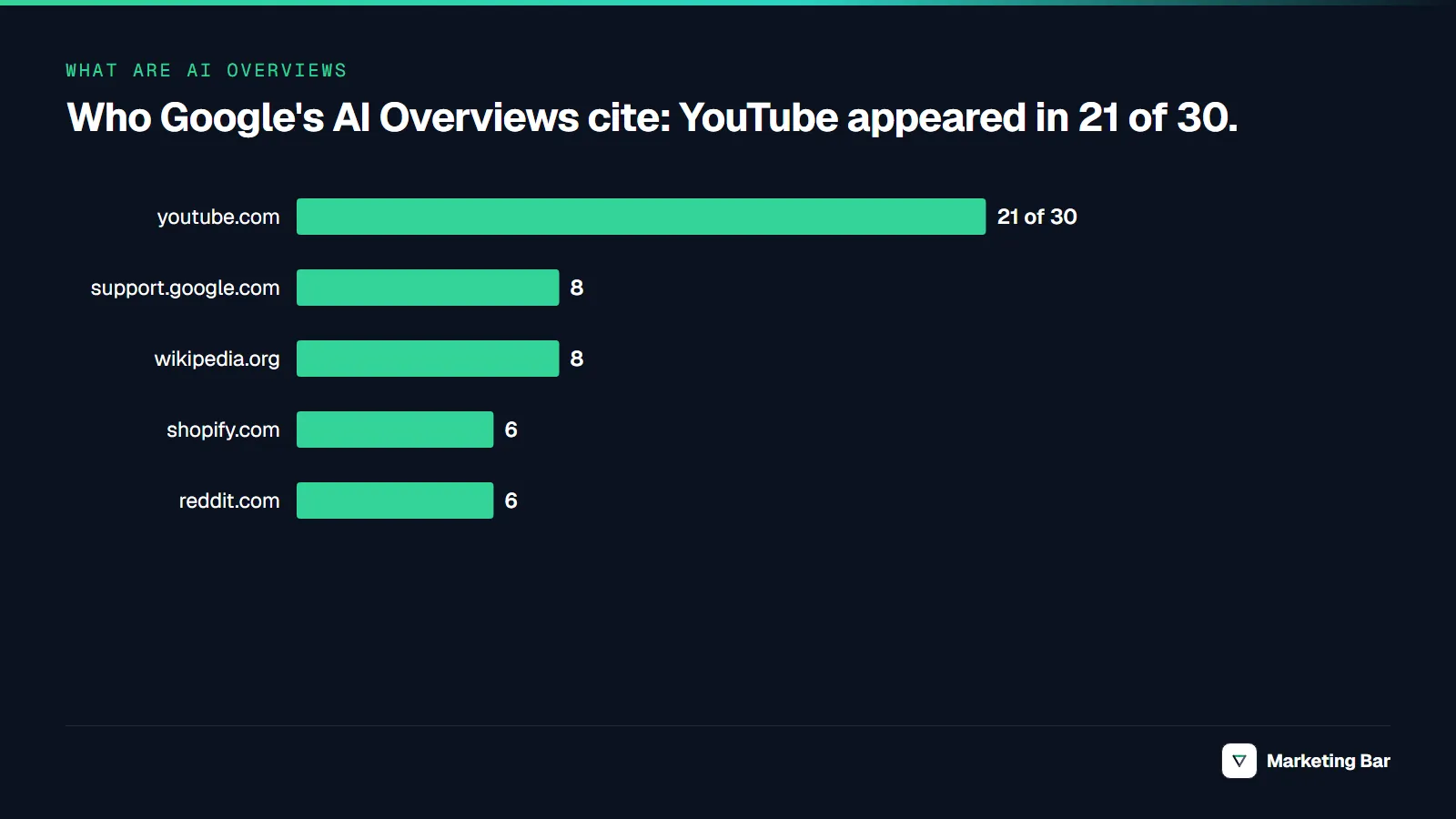
- In our test, 35 of 38 marketing queries showed an AI Overview. Of 184 citations, 57 (31%) went to domains in the page-one organic results. YouTube was cited in 21 of the 30 Overviews that listed sources.
- Searchers can't turn AI Overviews off. The "Web" filter (or
&udm=14in the URL) shows a links-only page.
What are AI Overviews?
AI Overviews are a Google Search feature that answers a query with a generated summary on top of the list of links. Google describes them as a way to "get to the gist of a complicated topic or question more quickly, and provide a jumping off point to explore links to learn more" (Google Search Central).
Google shows one "when our systems determine that generative AI can be especially helpful" (Google Search Help), and the text is written by Gemini; since January 2026, Gemini 3 is the default model for AI Overviews globally (Google, 2026).
An AI Overview example: search "roas formula" in the US and a block at the top of the results explains return on ad spend as revenue divided by ad spend, with links to supporting pages; "Show more" at the bottom opens the detailed view (Google Search Help). On October 7, 2026, it cited seven domains: Wall Street Prep, Unity, Triple Whale, Daasity, Count, Shopify and YouTube. Only Wall Street Prep also ranked in the page-one organic results.
When did Google AI Overviews start?
| Date | What happened | Source |
|---|---|---|
| May 10, 2023 | SGE (Search Generative Experience) launches as an opt-in experiment in Search Labs, US, English | Google, 2023 |
| May 14, 2024 | SGE becomes AI Overviews and rolls out to everyone in the US; the "Web" filter launches the same week | Google, 2024, TechCrunch, 2024 |
| May 30, 2024 | Google acknowledges "odd, inaccurate or unhelpful" Overviews and adds over a dozen fixes | Google, 2024 |
| October 28, 2024 | Expansion to 100+ countries and territories; 1 billion+ monthly users | Google, 2024 |
| May 20, 2025 | 200+ countries and 40+ languages; AI Mode rolls out to everyone in the US | Google, 2025, Google, 2025 |
| January 27, 2026 | Gemini 3 becomes the default model; follow-up questions from an Overview open AI Mode (mobile, global) | Google, 2026 |
AI Overviews vs AI Mode, ChatGPT search and Perplexity
All four summarize the web with links. They differ in where they live and who starts the conversation.
| Google AI Overviews | Google AI Mode | ChatGPT search | Perplexity | |
|---|---|---|---|---|
| Where it appears | Top of the normal Google results page | Separate tab in Google Search | Inside ChatGPT | Its own app and site |
| Who triggers it | Google, per query | The user, by opening AI Mode | ChatGPT decides, or the user clicks search | Every query |
| Follow-up questions | Opens AI Mode (mobile, since Jan 2026) | Yes, conversational | Yes | Yes |
| Underlying model | Gemini | Gemini | OpenAI models | Its own Sonar model; GPT, Claude, Gemini on paid plans (Perplexity) |
| Can you skip it? | No; use the Web filter | Yes, don't open the tab | Yes | It is the product |
Is AI Overview the same as ChatGPT? No. ChatGPT's web search launched on October 31, 2024 and draws on third-party search providers (OpenAI, 2024); AI Overviews live on Google's results page and use Google's index. Google's closer equivalent to ChatGPT is AI Mode, which issues "a multitude of queries simultaneously" per question (Google, 2025). Terminology: our SEO vs GEO vs AEO glossary.
How does Google choose the sources in an AI Overview?
What Google states:
- Eligibility is the same as regular Search. "To be eligible to be shown as a supporting link in AI Overviews or AI Mode, a page must be indexed and eligible to be shown in Google Search with a snippet." There are "no additional technical requirements" (Google Search Central).
- Query fan-out. Both features may issue "multiple related searches across subtopics and data sources," which lets them show "a wider and more diverse set of helpful links" than the classic results (Google Search Central).
- They run on the core ranking systems. Google says AI Overviews "integrate with our core web ranking systems" (Google, 2024).
- Existing controls apply.
nosnippet,data-nosnippet,max-snippetandnoindexlimit what can appear. AI-feature traffic stays in Search Console's Performance report under the "Web" search type; since June 2026 a separate generative AI performance view shows impressions (no clicks) from AI Overviews and AI Mode (Google Search Central Blog, 2026).
What Google rules out: "You don't need to create new machine readable files, AI text files, or markup to appear in these features," and "there's also no special schema.org structured data that you need to add" (Google Search Central). Treat paid advice built on llms.txt files or "AI schema" with that in mind.

From query to click. Fan-out explains why cited sources differ from the page-one results. Sources: Google Search Central; Marketing Bar SERP study, 2026-10-07; Pew Research Center, 2025.
Do AI Overviews reduce clicks?
In Pew Research Center's March 2025 browsing panel, users clicked a traditional result in 8% of visits to pages with an AI summary versus 15% without one, and clicked a link inside the summary in 1% of visits. Sessions ended on 26% of pages with a summary versus 16% without (Pew Research Center, 2025).
What we found: 38 marketing queries, one day
We pulled live US desktop results for 38 informational marketing queries on October 7, 2026 (method below). "Page one" here means the organic results among the first 10 SERP items, which came to 5–9 organic links per query.
| Measure | Result |
|---|---|
| Queries that showed an AI Overview | 35 of 38 (92%) |
| Overviews that listed cited sources | 30 of 35 |
| Cited domains per Overview | 3 to 10, median 5.5 |
| Citations, total / distinct domains | 184 / 109 |
| Citations to domains also in the page-one organic results | 57 of 184 (31%) |
| Overviews with no cited domain on page one | 5 of 30 |
| Overviews citing the #1 organic result's domain | 16 of 30 (53%) |
| Overviews citing YouTube | 21 of 30 (70%) |
| Overviews citing any Google-owned site (incl. YouTube) | 26 of 30 (87%) |
No Overview: "dreamdata" (a vendor name) and two requests for dashboard examples.
Ranking and being cited are different things
In our sample, ranking #1 got a domain cited only about half the time (16 of 30), and five Overviews cited nothing from page one. The clearest case: "what is roas" and "roas meaning" returned Overviews citing the same nine domains in the same order. For "roas meaning", four of those nine also ranked on page one. For "what is roas", none did. The source set came from something wider than the links below it, consistent with query fan-out.
Ambiguity carries over too: the Overview for the bare query "roas" was about Ross Stores, citing the retailer's own sites.
Who gets cited
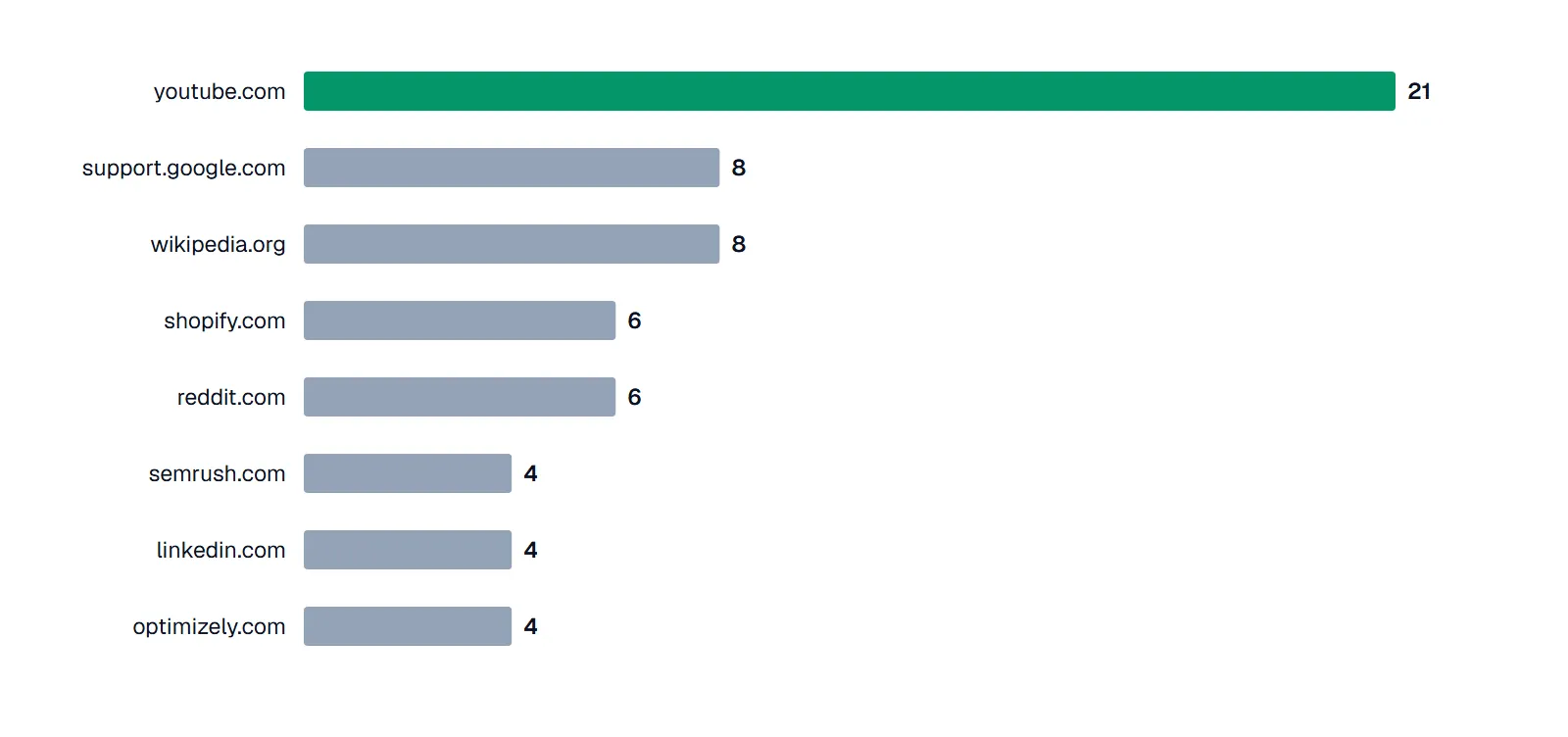
Number of AI Overviews (of 30) citing each domain. Domains counted by exact host (help.shopify.com etc. counted separately). Source: Marketing Bar SERP study, DataForSEO, US desktop, 2026-10-07.
We grouped all 184 citations by type of site, using our own judgment from each domain's homepage:
| Source type | Citations | Share | Also on page one |
|---|---|---|---|
| Software vendors & brands (Shopify, Semrush, Optimizely, HubSpot…) | 78 | 42% | 27 (35%) |
| Agencies & independent blogs | 31 | 17% | 5 (16%) |
| YouTube | 21 | 11% | 5 (24%) |
| Other Google pages (Help Center, Search Central, Google Business) | 20 | 11% | 7 (35%) |
| Forums & social (Reddit, LinkedIn, Facebook, Shopify Community, Quora, Medium) | 17 | 9% | 7 (41%) |
| Wikipedia & course sites | 12 | 7% | 5 (42%) |
| News & trade press | 5 | 3% | 1 (20%) |
| All | 184 | 100% | 57 (31%) |
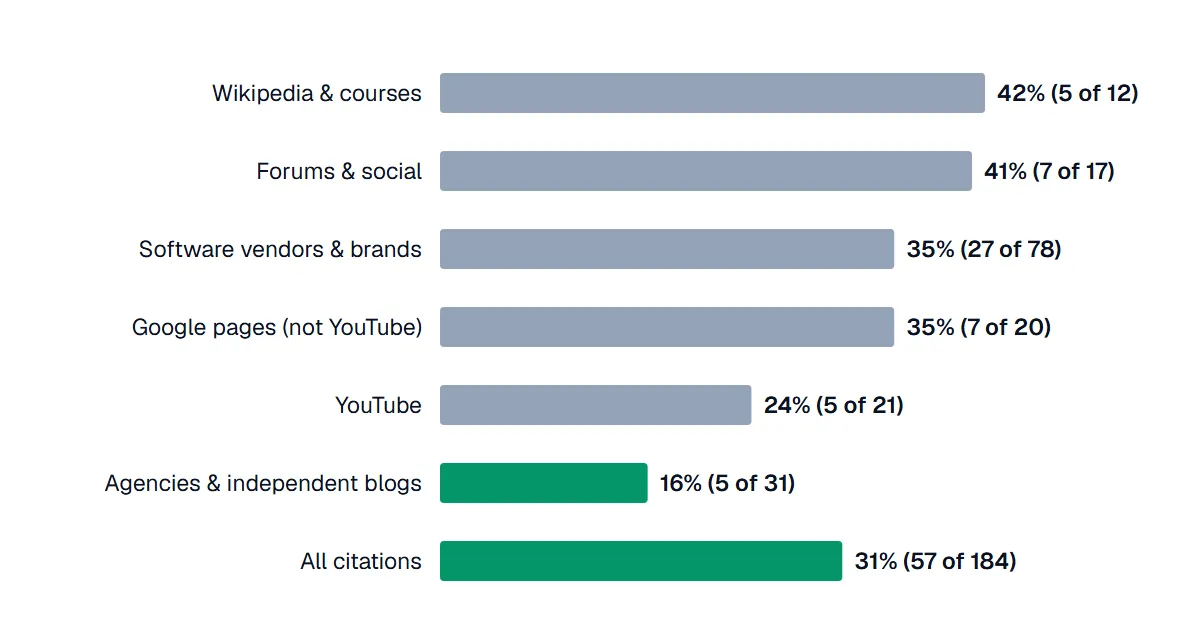
Agencies and independent blogs were cited mostly without ranking on page one: 26 of their 31 citations. Groups with n ≥ 12 shown; small groups (12–21 citations): treat differences under ~10 points as noise. Source: Marketing Bar SERP study, 2026-10-07.
Vendors are the biggest source type: 42% of citations, present in 25 of 30 Overviews. If you sell the thing being explained, your docs and blog are in the running. Wikipedia, YouTube and Reddit together made up 19% of our citations (35 of 184). Pew Research Center, which logged up to three source links per AI summary across all searches its panel ran in March 2025, also found these three were the most-cited sources (15% of links).
Are AI Overviews accurate?
Usually, but not reliably. Google's help page says "AI Overviews can and will make mistakes" (Google Search Help). After the 2024 launch suggested using glue to make cheese stick to pizza, Google said its accuracy rate is "on par with" featured snippets, limited satire and user-generated content, and tightened triggering for health queries (Google, 2024). Our "roas" result shows a milder failure: a correct answer to the wrong reading of an ambiguous query.
An Overview can describe your product from a forum thread or a competitor's page; checking that is part of tracking AI Overviews.
Can you turn off AI Overviews (and get normal Google back)?
No, not as a setting. Google's help page states: "Features cannot be turned off. However, you can select the Web filter after you perform a search" (Google Search Help). What works:
- The Web filter. After searching, choose "Web" (on desktop it may be under "More"). It shows text links only, without AI Overviews (TechCrunch, 2024).
&udm=14. Adding&udm=14to a Google search URL loads the links-only view without AI Overviews (PCWorld, 2026). Setting it in your browser's custom search engine URL makes every search open that view.- Browser extensions that hide the box (about 5,400 US searches a month for one, per DataForSEO, October 2026). They break when Google changes its markup.
How to appear in Google AI Overviews
Citation and ranking come apart, so what changes is which pages are worth building. The full playbook is in our LLM SEO guide; the decision table:
| If… | Then focus on |
|---|---|
| Your pages aren't indexed or are blocked from snippets | Technical fixes first; nothing else matters until a page can show a snippet |
| You rank on page one but aren't cited | Pages that answer the question in the first lines, with specifics a summary can lift |
| You're cited for some queries in a topic but not others | Cover the related sub-questions fan-out is likely to search, on the pages you already have |
| Competitors' explainers and YouTube dominate citations | A video and a docs-style page for the questions buyers ask about your category |
| Reddit or forums are cited about your brand | Participate where the thread is; you can't edit the summary, only its sources |
For DTC brands, the broader picture beyond Google is in what GEO means for DTC operators; to have it run for you, see our SEO, GEO and AEO service.
How we got these numbers
- Queries (n = 38): informational keywords with at least 90 US monthly searches from our October 2026 topic research, up to four per seed across 10 marketing topics (Shopify SEO, AI Overviews, Google Shopping ads, Facebook ads, GA4, conversion rate optimization, marketing attribution, ROAS, marketing dashboards, customer lifetime value).
- Collection: DataForSEO SERP API (Google organic, live, advanced), United States, English, desktop, depth 10, AI Overview loading enabled. One pull per query on October 7, 2026.
- Definitions: "AI Overview present" = an
ai_overviewitem in the results. "Citations" = unique domains in the Overview's reference list. "Page one" = the organic results among the first 10 SERP items; depth 10 counts AI Overviews, People Also Ask and video blocks as items, so this was 5–9 organic links per query. Matching is by exact host. - Source types: assigned by us from each domain's homepage; borderline cases are judgment calls.
- Limitations: one day, one location, one device, marketing queries only; Overviews vary by user, time and wording. Four queries were about AI Overviews themselves, where Google cites its own help pages. Five Overviews returned no reference list through the API; they count toward the 35 but not the citation figures. Pew found AI summaries on 18% of all searches its panel ran in 2025, so our 92% reflects the informational queries we chose, not Google overall.
FAQ
Searching "roas formula" in the US on October 7, 2026 returned an AI Overview explaining return on ad spend as revenue divided by ad spend, with links to seven sites including Wall Street Prep, Shopify and YouTube.
No. AI Overviews are written by Google's Gemini models on Google's results page. ChatGPT is OpenAI's assistant. Google's closest equivalent to ChatGPT is AI Mode.
Google shows one when its systems decide generative AI is helpful for the query, most often on questions and longer searches.
Not as a setting. Google says the feature can't be turned off, but the Web filter, or adding &udm=14 to the search URL, shows results without AI Overviews.
Yes, with the same controls as regular Search: nosnippet, data-nosnippet, max-snippet or noindex. Blocking Google-Extended does not do it: Google says it doesn't affect inclusion in Google Search; it governs Gemini training and grounding (Google Search Central).
No. In our 38-query test, 69% of citations went to domains not in the page-one organic results.