TikTok Ads Agency for DTC Beauty: What It Should Run
TikTok asks for a Smart+ daily budget of 10 to 30 times your CPA and at least six creatives at launch. That arithmetic, more than any agency pitch, decides whether a beauty brand is ready for paid TikTok.

A TikTok Ads agency for a DTC beauty brand should run four things: a steady supply of native 9:16 creative, Spark Ads on creator posts, a budget sized from TikTok's own CPA rule, and measurement through the TikTok Pixel plus the Events API, reconciled against Shopify orders. TikTok Shop's merchant side (catalog, fulfillment, affiliates) is a separate job, covered in our TikTok Shop agency guide.
The reader here is a skincare or color-cosmetics founder deciding whether to hire for TikTok. Every platform rule below comes from TikTok's own help center (checked Oct 2026; the rules can change). The budget table is our arithmetic on those rules, with the CPAs labelled as assumptions.
Key takeaways
- TikTok's Smart+ best practices ask for a daily campaign budget of ideally 30× your historical CPA and no less than 10×, at least six creative assets, and a run of at least seven days. At a $35 CPA that is $350 to $1,050 a day.
- Spark Ads run existing organic posts (yours or a creator's) as ads. The creator generates an authorization code in the app; the agency should track every code's expiry against the flight dates.
- Shoot vertical 9:16 at 720p or better, put the hook in the first 6 seconds and the proposition in the first 3, per TikTok's creative best practices.
- Measurement: Pixel plus Events API with a shared
event_id, and attribution windows chosen before launch, because TikTok locks them once the ad group is published. - TikTok's ad policy bars cosmetics ads from medical claims, including "remove or cure acne", "remove wrinkles" and "treat hair loss".
- Vet the agency on budget sizing, code management and measurement, and check TikTok's Marketing Partners directory. Both TikTok agency queries in our SERP snapshots show an AI Overview that cites it.
TikTok agency results skip budget floors, Spark Ads and measurement
Google returned 9 organic results for "tiktok ads agency" (DataForSEO, US desktop, 2026-10-24):
| Result type | Count | Examples |
|---|---|---|
| Ranked agency lists | 3 | admanage.ai "10 Best TikTok Ads Agencies", nogood.io "15 Best", houseofmarketers.com "Best for US Brands" |
| Agency service pages | 3 | crklr.com, growmojo.com, theinfluencermarketingfactory.com |
| Reddit threads | 2 | r/advertising on finding creators and agency account access |
| YouTube | 1 | Setting up a TikTok agency ad account |
The AI Overview on that query cited three domains: ads.tiktok.com, reddit.com and partners.tiktok.com (TikTok's Marketing Partners directory). Across all 153 SERP snapshots we took for our articles on 2026-10-24, the only two TikTok-agency queries ("tiktok ads agency" and "tiktok shop agency") both had an AI Overview citing partners.tiktok.com. A second snapshot for "tiktok ads for beauty brands" (2026-10-26, 8 organic results) returned brand-campaign roundups, TikTok's own inspiration pages and two TikTok Shop agency pages, with no People Also Ask box.
What none of the beauty or agency pages explains: how much budget TikTok's own rules require before a test means anything, how Spark Ads authorization works in practice, and how to set up measurement so TikTok's revenue figure can be checked.
The budget math TikTok's own rules imply
TikTok's Smart+ Web campaign best practices say: "You should ideally set a daily campaign budget of 30 times your historical CPA and no less than 10 times your historical CPA." The same page asks for at least six creative assets and a run of at least seven days. Separately, the budget rules set hard floors of $50 a day per campaign and $20 a day per ad group, and cap budget increases at 40% per adjustment during the learning phase and 30% after it, no more often than every two days.
Applied to three CPAs (assumptions for illustration; use your own historical CPA from Meta or TikTok):
| Assumed CPA | 10× floor per day | 30× ideal per day | 10× floor, 30 days | 30× ideal, 30 days |
|---|---|---|---|---|
| $20 | $200 | $600 | $6,000 | $18,000 |
| $35 | $350 | $1,050 | $10,500 | $31,500 |
| $50 | $500 | $1,500 | $15,000 | $45,000 |
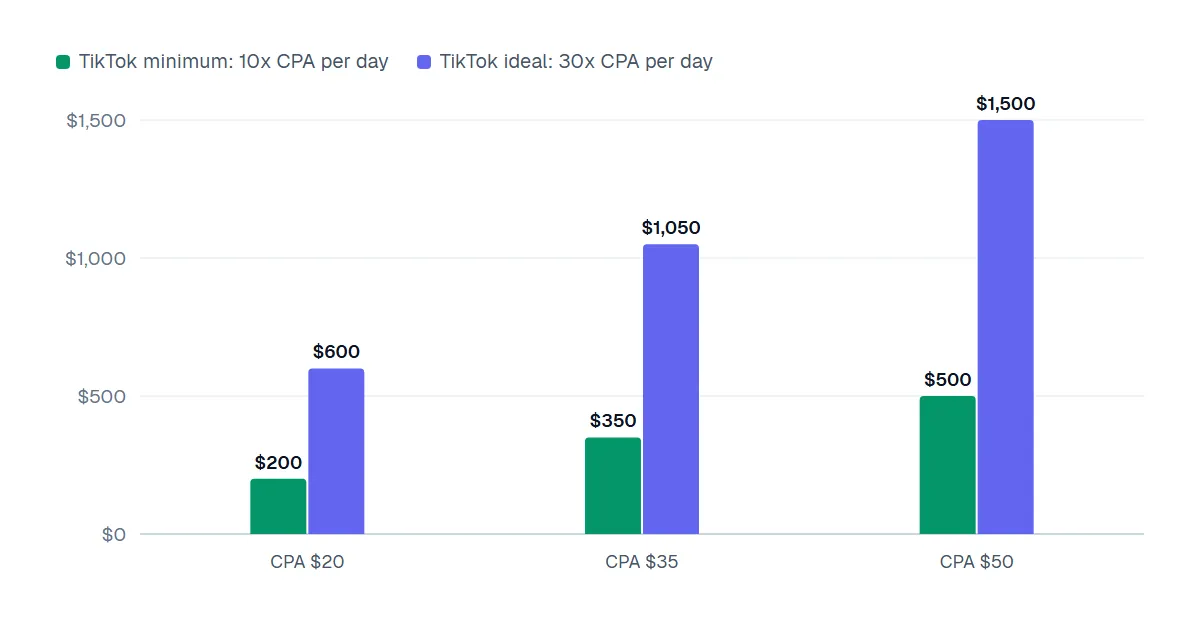
At a $35 CPA, TikTok's Smart+ guidance means $350 to $1,050 a day. Source: TikTok Ads Smart+ Web best practices (checked Oct 2026); CPAs are assumptions, not benchmarks.
Scaling takes time too. At the 30% cap with changes at least two days apart, getting from $200 to $600 a day takes five increases ($260, $338, $439, $571, $743), so at least 10 days. The budget table multiplies three assumed CPAs by the 10× and 30× factors in TikTok's Smart+ guidance, and this scaling sequence compounds TikTok's 30% cap. A plan that promises full spend in week one breaks TikTok's own budget guidance.
Smart+ or manual campaigns
Smart+ is TikTok's AI campaign type: TikTok automates targeting, optimization and creative selection, and you can switch individual modules (targeting, budget, catalog ads, placements) between automated and manual. Manual campaigns follow TikTok's creative best practices: 3–5 creatives per ad group and 3–5 ad groups per campaign, so 9–25 live creatives in one campaign.
Either way, the agency's real input is creative volume and clean conversion data. For Shop sales the choice is already made: since July 2025, GMV Max is "the default and only supported campaign type for TikTok Shop Ads", replacing Product, Video and LIVE Shopping Ads. How GMV Max blends organic, affiliate and paid creative is covered in the TikTok Shop guide.
Spark Ads: how they work and what to ask
TikTok describes Spark Ads as "a native ad format that allows you to leverage organic TikTok posts and their features in your advertising." For beauty, that usually means a creator's routine, tutorial or ingredient video runs as the ad, with the creator's handle and engagement intact.
The workflow, per TikTok's creation guide and FAQ (checked Oct 2026):
- The creator opens the video, taps the three dots, then Ad settings, then Generate to create the post code.
- The advertiser adds the post in Ads Manager; up to 20 codes can be authorized in one batch.
- Each code has an authorization period. Ads Manager flags codes that expire or end before the ad's end date, and a sparked video must be un-authorized before the creator can delete it.
- Sparked videos can be up to 10 minutes; one Ads Manager account supports up to 10,000 Spark Ads.
What to ask the agency: who keeps the code log, how expiries are matched to flight dates, and whether paid usage rights are in the creator contract before production. Our UGC agency guide covers usage rights in detail.
Creative specs and what to brief
| Spec (auction In-Feed, non-Spark) | TikTok's rule |
|---|---|
| Aspect ratio | Vertical 9:16 recommended, at least 540×960 px; 16:9 and 1:1 also accepted |
| Resolution to shoot | At least 720p |
| Duration | Up to 10 minutes (Spark Ads: no restriction) |
| File | .mp4, .mov, .mpeg, .3gp or .avi; up to 500 MB; bitrate at least 516 kbps |
| Ad caption | No clickable links, @ mentions or hashtags |
| Hook | Hook in the first 6 seconds; content proposition in the first 3 seconds |
| Sound | Use sound or music |
| Refresh | When delivery shows a consistently declining trend; add new creatives to the existing ad group instead of opening a new one |
Sources: TikTok auction In-Feed ad specs and creative best practices, checked Oct 2026.
The vertical rule has outside evidence behind it. In a 2022 Magna study for TikTok, reported by Magna, the same ad shown vertically reached 44% recall against 35% horizontal, and 8% purchase intent against 3%. Respondents also said native ads "felt more like content" than repurposed ones. That study is from 2022 and the article doesn't state the sample size; treat it as direction, not a benchmark.
For beauty, the formats that fit those specs are the ones creators already make: ingredient explainers, full-look tutorials and "get ready with me" videos. Which of them sells your product is something your account has to test. For the creative patterns on skincare specifically, see our skincare advertising 2026 piece. For how to vet the production partner, see the guide to choosing a content creation agency.
Measurement: set it up before the first dollar
Three settings decide whether TikTok's revenue number can be trusted:
- Pixel plus Events API, deduplicated. TikTok recommends both and deduplicates only when the same event carries the same
event_idon both channels (an order ID for Purchase works). Without it, one order can count twice. - Attribution window chosen up front. Ad groups offer 1, 7, 14 or 28 days click-through and off, 1 or 7 days view-through, and "attribution settings cannot be changed once the ad group has been published" (TikTok, page updated Nov 2025). Write the setting next to every ROAS figure.
- One purchase event per platform, reconciled to Shopify. Every platform credits the sales it touched inside its own window, so TikTok, Meta and email revenue summed together exceed Shopify's order total. Mapping matters inside one platform too: in one anonymized DTC brand's account connected to Level, Meta's API reported the same purchase under five event names, and summing them gave 12.63× ROAS instead of 2.53× (Q3 2026, absolute amounts withheld). The ROAS formula guide walks through that case.
Claims: what TikTok's ad policy blocks for beauty
TikTok's healthcare and pharmaceuticals policy (updated Sept 2026) tells cosmetics and beauty advertisers: "Do not make medical claims," unless they hold an approved medical license or certification. Its not-allowed examples include "claims to remove or cure acne, remove wrinkles, or treat hair loss" and "performance promises referencing permanent changes to the human body." Weight-related products have a separate weight management policy that bars exaggerated or guaranteed results.
This applies to the creator's words in a Spark Ad as well as your own script, so the agency should review creator scripts before they film. The US legal layer on top (FTC substantiation, cosmetic vs drug claims) is covered in our beauty marketing agency guide.
Where TikTok Shop fits
TikTok Shop is a marketplace inside the app with its own checkout, and its paid layer is GMV Max. It is a separate operational job from TikTok Ads: catalog, fulfillment, customer service and affiliate creators. If your brand isn't staffed for that, run TikTok Ads to your Shopify store and add Shop later; our TikTok Shop agency guide covers what a specialist partner should take on. Parts of the merchant load, such as inventory sync and service routing, can be automated; our marketing automation agency guide covers how to scope that. If your SKU count and price point point to an established marketplace instead, the Amazon ads agency guide covers that channel's very different bid and ranking dynamics.
How to vet a TikTok Ads agency
Ask for the budget math
Give them your historical CPA and ask what daily budget they'd launch at and why. An answer that ignores TikTok's 10–30× CPA guidance for Smart+, or promises full spend in the first week, is a red flag.
Check the partner directory
TikTok's Marketing Partners page lists badged partners in four categories: Agency, Creative, Measurement and Marketing Technology. A badge is a filter, not a guarantee; ask which category and for what.
Confirm who owns the accounts
The ad account, Business Center, Pixel and Events API connection should sit with the brand, with the agency added as a partner.
Ask how Spark Ads codes and rights are managed
Who requests codes, who logs expiries, and where the paid usage rights for each creator are written down.
Ask for the measurement setup in writing
Event deduplication via event_id, the attribution window per ad group, and how TikTok revenue is reconciled against Shopify orders.
Ask who reviews claims
Creator scripts checked against TikTok's cosmetics policy before filming, not after a rejection.
What we do and won't do on TikTok engagements
Our TikTok creative team runs paid ads management, UGC-style creative production and tracking; TikTok Shop merchant operations and livestream production stay with the brand's team or a specialist partner. Native creative production, the kind our creatives team runs for skincare and color cosmetics, is part of the scope. For brands that need a creator bench, we work as a UGC agency inside the same engagement. Pricing depends on ad spend and creative volume; contact us for a scoped quote.
What we won't do:
- Run cross-posted Meta creative without a native production budget. If there's no budget for 9:16 creative, we recommend not running TikTok yet.
- Take on TikTok Shop merchant operations. Catalog, fulfillment and customer service belong with the brand's team or a Shop specialist.
- Promise virality. We optimize paid performance and treat organic lift as upside.
- Report TikTok in isolation. TikTok revenue is reconciled against Shopify alongside Meta and Google.
If TikTok's budget floor is out of reach for now, YouTube ads can carry the same video-first creative into a longer-consideration funnel instead.
FAQ
How much should a beauty brand budget for TikTok ads to start?
For a Smart+ conversion campaign, TikTok asks for 10× your historical CPA per day at minimum and 30× ideally, for at least seven days. At a $35 CPA that is $350 to $1,050 a day. Manual campaigns can start at TikTok's floors of $50 a day per campaign and $20 per ad group, but the result is a directional read.
Are Spark Ads better than regular In-Feed ads for beauty?
TikTok doesn't publish a like-for-like comparison on its help pages. Spark Ads keep the creator's handle and engagement on the ad, which suits beauty content creators already make; test them against non-Spark versions of the same video in your account.
Do I need TikTok Shop to run TikTok ads?
No. TikTok Ads can drive traffic to your Shopify store. Shop is a separate marketplace with its own ad type (GMV Max) and its own merchant work; see the TikTok Shop agency guide.
Beauty channel mix, PPC scope and sizing a TikTok test
For the channel mix and claims rules across beauty, start with our beauty marketing agency guide; for creative patterns, the skincare advertising 2026 article is the cross-cluster sibling. For the broader PPC engagement scope, our paid advertising service covers Meta, Google and TikTok together. For a free first-pass review of your current TikTok account, our PPC audit covers TikTok as part of the standard audit. For the operating cadence day to day, our PPC management services breakdown covers the platform-agnostic discipline. To size a TikTok test on your own CPA with us, contact us.