How Much Does Google Ads Cost per Month? DTC Budget Math
A Google Ads budget is three numbers multiplied together: the conversions you need, the share of clicks that convert, and what a click costs. We measured the third one for 70 DTC product categories.

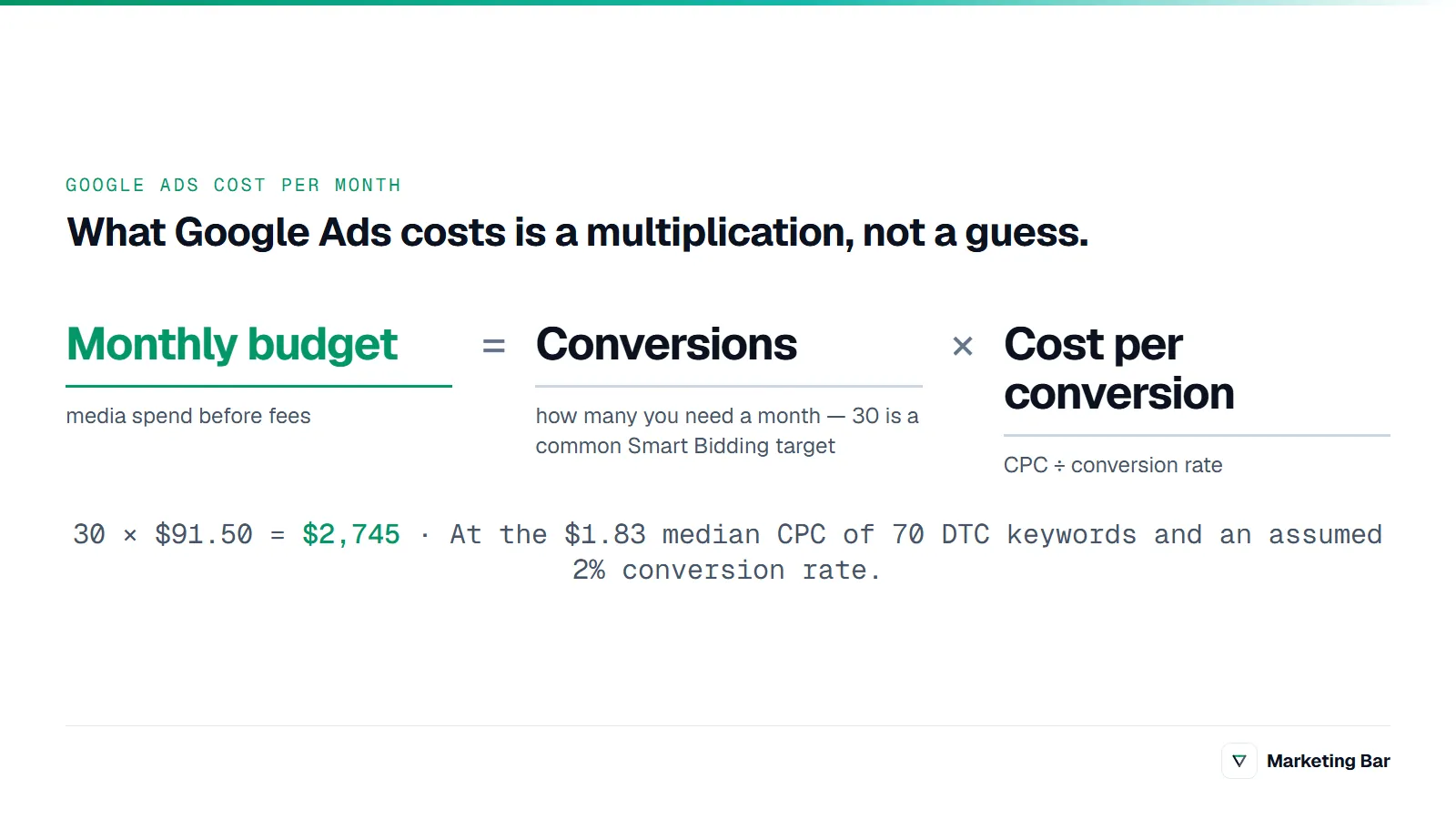
For a DTC brand bidding on product keywords, Google Ads typically costs about $1,400–$2,700 a month in clicks to reach the 15–30 monthly conversions Google's automated-bidding guidance asks for (at the $1.83 median CPC and a 2% conversion rate); Google itself charges nothing beyond clicks and bills at most 30.4× your daily budget per month. Across 70 US product keywords we pulled on 2026-10-07, the median cost per click was $1.83, with a range from $0.53 (kombucha) to $23.08 (meal kit, a subscription service). A common working target of 30 conversions a month costs about $2,745 a month, or $90 a day, at those numbers.
Below: CPC for product keywords only, split by category, and the budget math to rerun with your own numbers.
Key takeaways
- Google Ads has no monthly fee. You set an average daily budget; Google can spend up to 2× it on a given day but bills no more than 30.4× it per month.
- In our sample of 70 DTC product keywords, the median CPC is $1.83; half of them sit between $1.38 and $2.76. Seven cost $5 or more per click.
- Size the budget backwards: budget = conversions needed × (CPC ÷ conversion rate). At $1.83 and 2%, each conversion costs about $91.50 in clicks.
- $20 a day buys about 330 clicks a month at the median CPC. That is enough to test a few keywords and too little for automated bidding to learn.
- Management is extra: commonly 10–20% of spend (OuterBox, an agency, 2026), up to 30% in other agency price guides, often with a minimum fee.
How does Google Ads pricing work?
Google Ads is an auction. Every time someone searches, Google ranks the eligible ads by bid and expected quality and charges each advertiser only when their ad is clicked. Per Google Ads Help (2026), "you only pay what's minimally required to clear the Ad Rank thresholds and beat the Ad Rank of the competitor immediately below you," so the actual cost per click is often lower than your maximum bid.
You control spend with an average daily budget, set per campaign. Two rules from Google Ads Help on overdelivery decide what you are charged:
- On a single day a campaign "might spend up to twice your average daily budget" when traffic spikes.
- Over a month you "will have spent no more than 30.4 times your average daily budget."
So the monthly ceiling is simple arithmetic: daily budget × 30.4. A $50/day campaign will never bill more than $1,520 in a month, whatever happens on individual days.
What does a Google Ads click cost for a DTC brand?
For product keywords, less than the headline averages suggest. WordStream's 2026 benchmark (13,000+ Search campaigns, April 2025–March 2026) puts the all-industry average CPC at $5.42 (WordStream, 2026, checked Oct 2026), but that average is pulled up by legal ($9.87), home improvement ($8.33) and dental ($8.00) leads. In our sample of 70 DTC product categories, 42 cost $2 or less per click. These are Search keyword CPCs; Shopping and Performance Max clicks price differently (see Limitations).
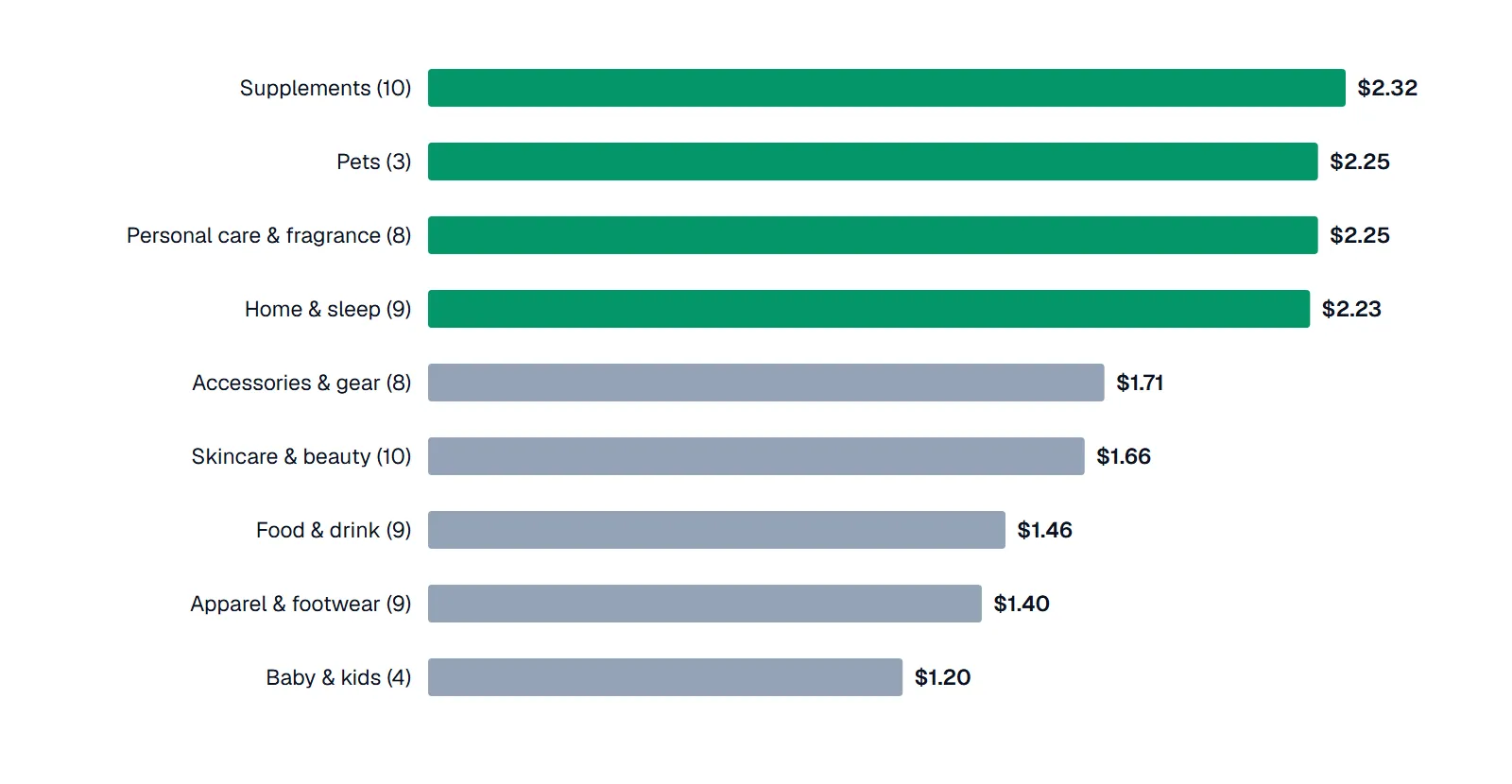
Supplements, pets, personal care and home run about $2.25 per click; apparel and baby products closer to $1.20–$1.40. Overall median $1.83. Green: above the overall $1.83 median. Source: Marketing Bar analysis, DataForSEO Labs (Google Ads data), US, 2026-10-07; number of keywords per group in brackets.
| Category group | Keywords | Median CPC | Cheapest → most expensive |
|---|---|---|---|
| Supplements | 10 | $2.32 | melatonin gummies $0.90 → greens powder $4.74 |
| Pets | 3 | $2.25 | cat litter $2.09 → dog food $8.13 |
| Personal care & fragrance | 8 | $2.25 | toothpaste $1.38 → teeth whitening $5.26 |
| Home & sleep | 9 | $2.23 | yoga mat $1.36 → mattress $11.73 |
| Accessories & gear | 8 | $1.71 | water bottle $0.89 → engagement ring $6.08 |
| Skincare & beauty | 10 | $1.66 | dry shampoo $1.20 → hair growth serum $4.26 |
| Food & drink | 9 | $1.46 | kombucha $0.53 → meal kit (subscription) $23.08 |
| Apparel & footwear | 9 | $1.40 | hoodie $0.77 → linen shirt $2.67 |
| Baby & kids | 4 | $1.20 | stroller $0.81 → baby carrier $1.89 |
| All 70 keywords | 70 | $1.83 | $0.53 → $23.08 |
The spread inside a group is wider than the spread between groups. "Food & drink" holds both the cheapest keyword in the set and the most expensive one. Category tells you roughly where to start; the specific product decides the bill.
Why WordStream's retail CPCs are about double ours
WordStream's retail-adjacent categories run $3.97–$4.62 per click: Furniture $3.97, Animals & Pets $4.06, Shopping, Collectibles & Gifts $4.14, Apparel / Fashion & Jewelry $4.44, Beauty & Personal Care $4.62 (WordStream, 2026). That is roughly twice our $1.83 median. WordStream averages what real accounts paid across every keyword they bid on; ours is Google's historical average for one generic product term each. As a cross-check on cost per conversion, WordStream reports $49.40 per lead for Shopping, Collectibles & Gifts at a 4.01% conversion rate, against $91.50 from our $1.83 median at an assumed 2%. Same order of magnitude; most of the gap is their conversion rate being double our assumption.
The 10 most and least expensive keywords
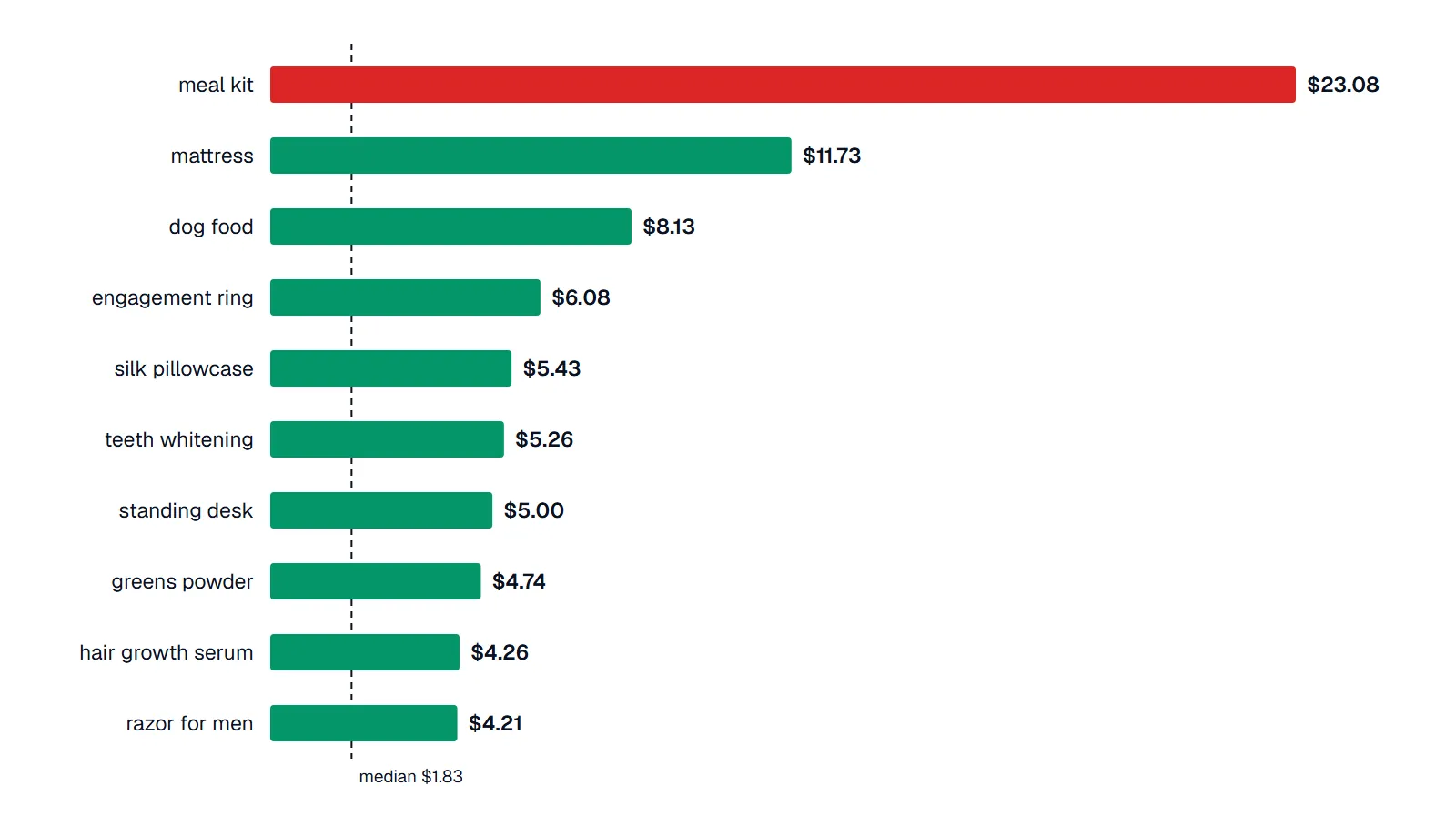
Meal kit, a subscription service, costs 12.6× the median click. Source: Marketing Bar analysis, DataForSEO Labs (Google Ads data), US, 2026-10-07.
| Most expensive | CPC | Top-of-page bid range | Least expensive | CPC |
|---|---|---|---|---|
| meal kit | $23.08 | $7.04–$24.23 | kombucha | $0.53 |
| mattress | $11.73 | $3.03–$18.85 | hot sauce | $0.64 |
| dog food | $8.13 | $3.21–$27.67 | hoodie | $0.77 |
| engagement ring | $6.08 | $1.67–$7.16 | stroller | $0.81 |
| silk pillowcase | $5.43 | $0.91–$5.88 | sneakers | $0.88 |
| teeth whitening | $5.26 | $2.24–$6.97 | water bottle | $0.89 |
| standing desk | $5.00 | $0.87–$6.98 | melatonin gummies | $0.90 |
| greens powder | $4.74 | $1.71–$10.95 | protein bars | $0.96 |
| hair growth serum | $4.26 | $0.88–$6.00 | coffee beans | $0.98 |
| razor for men | $4.21 | $2.14–$7.02 | diaper bag | $1.00 |
The expensive end is likely driven by subscription, repeat-purchase or high-ticket products (meal kits, mattresses, dog food, engagement rings), where one customer is worth enough that advertisers can pay more per click.
Google Ads budget calculator: the three-line formula
Start from the result you need:
clicks needed   = conversions needed ÷ conversion rate
monthly budget  = clicks needed × CPC
daily budget    = monthly budget ÷ 30.4

The budget math at the median DTC CPC. The 2% conversion rate is an assumption; use your own. Source: CPC from Marketing Bar analysis, 2026-10-07; 30.4-day cap from Google Ads Help.
The same math gives your cost per acquisition directly: CPA = CPC ÷ conversion rate. At $1.83 and 2%, that is $91.50 per conversion in click costs alone. Flip it and you get the most you can afford per click: break-even CPC = order value × gross margin × conversion rate. Illustrative numbers: an $80 first order at a 50% margin and a 2% conversion rate supports $0.80 per click before the sale loses money. That is below the median of every category group in our table. At those illustrative numbers, first-order economics don't work in any category group; the account has to pay back through repeat purchases, a higher order value, or a conversion rate above 2%.
How many conversions does Google need to learn?
Google's automated bidding needs volume. For Target ROAS on Search and Shopping, Google Ads Help requires "at least 15 conversions in the past 30 days at the conversion tracking level." Google's Display guidance recommends at least 30 conversions per month per ad group if you need to hit a CPA/ROAS target consistently (Google Ads Help); we use the same 30 as a working target for Search. More, 50 or above, makes bidding steadier still.
Here is what those two thresholds cost by category, at the group's median CPC and an assumed 2% conversion rate (15 conversions = 750 clicks, 30 conversions = 1,500 clicks):
| Category group | Median CPC | Budget for 15 conv./month | Budget for 30 conv./month |
|---|---|---|---|
| Supplements | $2.32 | $1,740 | $3,480 |
| Pets | $2.25 | $1,688 | $3,375 |
| Personal care & fragrance | $2.25 | $1,688 | $3,375 |
| Home & sleep | $2.23 | $1,673 | $3,345 |
| Accessories & gear | $1.71 | $1,283 | $2,565 |
| Skincare & beauty | $1.66 | $1,245 | $2,490 |
| Food & drink | $1.46 | $1,095 | $2,190 |
| Apparel & footwear | $1.40 | $1,050 | $2,100 |
| Baby & kids | $1.20 | $900 | $1,800 |
Conversion rate of 2% is an assumption for illustration. Halve it and every budget doubles; at 4% every budget halves.
What $20, $50 and $100 a day buy
| Daily budget | Max monthly charge (× 30.4) | Clicks at $1.83 | Conversions at 2% (assumed) | Range at 1–3% |
|---|---|---|---|---|
| $20/day | $608 | 332 | 7 | 3–10 |
| $50/day | $1,520 | 831 | 17 | 8–25 |
| $100/day | $3,040 | 1,661 | 33 | 17–50 |
Below about $45 a day, a DTC account at median CPCs and 2% conversion will not reach the 15-conversion threshold (Google counts the 15 at the conversion-tracking level, usually account-wide), so automated bidding has little to learn from. A small budget is still useful for testing keywords and protecting brand terms (see FAQ).
Is the spend paying back?
Clicks are cost; the question is what they return. Enter a month's spend, the revenue Google attributes to it, and your gross margin:
ROAS calculator
ROAS = attributed revenue ÷ ad spend · break-even ROAS = 1 ÷ contribution margin
- ROAS
- 3.00× 300% · 3.0:1
- ACoS
- 33%
- Break-even ROAS
- 2.50×
- Profit after ad spend
- $300
Above break-even: each sale covers its ad cost at a 40% margin.
At a 40% margin, break-even ROAS is 2.5×. The example above returns 3.0×, so each sale covers its ad cost with some room. Our break-even ROAS guide covers which costs belong in the margin.
Shopping campaigns depend on the product feed as much as on bids; our Google Shopping feed guide covers that side, and the Google Ads optimization checklist for DTC covers the rest of the account.
What does Google Ads management cost?
On top of media spend, someone has to run the account. OuterBox's 2026 pricing guide puts percentage-of-spend models "around 10% to 20% of monthly media spend, often with a minimum management fee," and lists typical fees by spend level (OuterBox, 2026, checked Oct 2026):
| Monthly ad spend | Typical management fee (OuterBox, 2026) |
|---|---|
| $1,000–$5,000 | $500–$2,000 |
| $5,000–$25,000 | $1,500–$5,000 |
| $25,000–$100,000 | $4,000–$12,000 |
| $100,000+ | $10,000–$25,000+ |
Other agency price guides stretch the percentage model to "10-30%" (310 Creative, 2026, checked Oct 2026). The three common models are a percentage of spend, a flat monthly retainer, and a flat fee plus a smaller percentage. At small budgets the minimum fee dominates: a $500 fee on $1,500 of spend adds a third to your cost per conversion. Our Google Ads management services for DTC and PPC management services articles cover how to compare proposals. For Marketing Bar's own approach, see paid advertising.
Total monthly cost
Putting the pieces together for an account sized to the 30-conversion target at the median CPC:
| Line | Monthly cost | Basis |
|---|---|---|
| Media (clicks) | ~$2,745 | 1,500 clicks × $1.83, 2% conversion assumed |
| Management | $500–$2,000 | OuterBox, 2026, tier for $1,000–$5,000 spend; $0 if run in-house |
| Creative, feed and tools | your estimate | Assumption: not benchmarked here; $0 if you reuse product photos and your store's native feed |
| Total | ~$3,245–$4,745 + creative/tools |
70 DTC keywords, priced on 2026-10-07
The CPC figures are DataForSEO Labs keyword data, which reports Google Ads figures: average CPC, low and high top-of-page bid, and monthly search volume (United States, English, pulled 2026-10-07). The sample is 70 generic product-category keywords a DTC brand would bid on ("protein powder," "silk pillowcase," "dog food"), chosen by us to cover nine category groups; group assignment is ours, and there are no brand or competitor terms.
CPC here is Google Ads' historical average CPC for the keyword across all advertisers, as surfaced by DataForSEO Labs (refreshed monthly; retrieved 2026-10-07). It is an estimate of the market price, not a quote for your account. The top-of-page bid range is a separate Google estimate, and CPC falls outside it for 4 of 70 keywords: collagen powder ($3.28 vs $1.17–$2.84), creatine ($2.73 vs $0.35–$2.71) and kombucha ($0.53 vs $0.02–$0.50) sit above the high end; toothpaste ($1.38 vs $1.93–$3.26) sits below the low end.
All of these are Search keyword averages. Shopping and Performance Max auctions price differently, long-tail and brand queries are usually cheaper, and your CPC depends on your Quality Score, bidding and competition on the day. Small groups (pets, 3 keywords; baby & kids, 4) are indicative only. Conversion rates in the budget tables are assumptions, not measurements.
FAQ
Only clicks (or other billable interactions, depending on campaign type). Google lists no flat fees or monthly subscriptions (Google Ads). You set an average daily budget, and Google bills no more than 30.4× that amount per month per campaign. Management fees, if you hire someone, are separate.
One that buys enough conversions for bidding to learn: at the $1.83 median DTC CPC and a 2% conversion rate, about $1,400 a month for 15 conversions and $2,745 for 30. Recalculate with your own CPC and conversion rate using the three-line formula above.
It buys about $608 a month, or roughly 330 clicks at the $1.83 median DTC CPC, which is around 7 conversions at a 2% conversion rate. That is enough to test a handful of tightly matched keywords or protect your brand terms, and not enough for Target CPA or Target ROAS to learn.
1,000 × your CPC. In our 70 DTC product keywords that ranges from $530 (kombucha) to $23,080 (meal kit), with $1,830 at the median.
Most likely you hit your payment threshold. With automatic payments, Google charges at the start of each month or whenever costs reach the threshold. The threshold starts low and rises each time you hit it before month end; Google's own example goes $50 → $200 → $350 → $500 (Google Ads Help). Check Billing → Summary for the costs behind the charge.
It depends on your margin, not on the year. If your break-even CPC (order value × margin × conversion rate) is above what your keywords cost, or repeat purchases make up the difference, Google pays back. If not, more budget only loses money faster.
Use the three-line formula above with CPC estimates for your own keywords from Google Keyword Planner.