LLM SEO: How Brands Get Cited by AI Search in 2026
AI answer engines cite passages they can lift whole, from pages their own crawlers are allowed to fetch. In 75 AI Overviews we checked, 64% of cited domains were not in that query's organic results, and Reddit was cited in 29.


LLM SEO is the work of getting your pages retrieved, quoted and linked by AI answer engines: ChatGPT search, Perplexity, Gemini, Copilot and Google's AI Overviews. Three things decide it. The engine's own crawler has to be allowed to fetch the page, the page needs a self-contained passage that answers the question, and the engine has to see enough corroboration elsewhere on the web to name your brand. Classic rankings help with the first round and don't settle the rest: in our snapshot of 153 searches on 2026-10-24, only 36% of the domains cited in AI Overviews also appeared in that query's organic results.
This guide covers the mechanics a DTC team can act on this week. For what a GEO agency engagement should include and how to score a proposal, see our generative engine optimization agency guide; for the measurement stack, see how to track AI Overviews.
Key takeaways
- Each engine has its own access rule. ChatGPT search shows sites that allow OAI-SearchBot; blocking GPTBot only opts you out of training. Perplexity search uses PerplexityBot. AI Overviews need nothing beyond normal Google indexing and snippet eligibility.
- Engines lift passages. Write each section so its first two to four sentences answer one question with named entities and no pronouns pointing back up the page.
- Ranking isn't enough. Of 225 domains cited across 75 AI Overviews we checked, 81 (36%) were also in that query's organic results; in 32 of the 75, none were.
- Third-party pages carry the citations. Reddit was cited in 29 of the 75 Overviews and YouTube in 19; no brand or vendor site was cited in more than 4.
- If you want this run for you, our SEO + GEO + AEO service covers the full loop. Contact us.
How AI answer engines choose what to cite
AI search surfaces broadly run the same three steps: retrieve candidate documents, extract the passages that best answer the question, and write an answer that links a few of them. Your page competes twice: once to be retrieved, once to be the passage that gets lifted. The first round is mostly crawl access and indexing. The second is about how the page is written.
Retrieval is wider than the query the user typed. Google says both AI Overviews and AI Mode "may use a 'query fan-out' technique", issuing related searches across subtopics and data sources (Google Search Central, checked Oct 2026). A question like "best skincare marketing strategy for a new brand" can pull candidates for channel mix, budget, and creative separately. That's why a page can be cited for a query it doesn't rank for, and why a page that covers ten sub-questions in one paragraph each tends to lose every one of them to pages that answer one thoroughly.
Who each engine lets in
| Engine | What has to be true for a page to be cited | Source (checked Oct 2026) |
|---|---|---|
| Google AI Overviews and AI Mode | Indexed and eligible to show in Search with a snippet. No extra files or markup required | Google: AI features and your website |
| ChatGPT search | OAI-SearchBot allowed. "Sites that are opted out of OAI-SearchBot will not be shown in ChatGPT search answers." GPTBot is a separate, training-only setting | OpenAI: crawlers |
| Perplexity | PerplexityBot allowed; it is "designed to surface and link websites in search results on Perplexity" and is not used for model training | Perplexity: bots |
| Gemini apps | Google-Extended controls training and grounding in Gemini apps; it "does not impact a site's inclusion in Google Search" | Google: common crawlers |
| Copilot and Bing AI answers | Indexed by Bing. Bing Webmaster Tools reports how often Copilot and Bing AI summaries cite your pages | Bing Webmaster Blog, Feb 2026 |
The practical consequence: a robots.txt that blocks "AI bots" as a group can remove you from ChatGPT and Perplexity search, while a robots.txt that blocks only GPTBot and Google-Extended keeps you in both search products and out of training. Decide each line on purpose.
The passage is the product: writing sections an engine can lift
The change that pays off most in LLM SEO is opening every section with a complete, self-contained answer of two to four sentences: subject named, question resolved, no "this" or "it" pointing at the previous paragraph. A passage that starts "This is why it matters" can't be quoted on its own, because "this" means nothing outside the page.
The format, section by section:
- Question-shaped H2s. Each heading maps to one sub-question a buyer asks. The heading is what retrieval matches; the opening block is what gets quoted.
- Answer first, then the support. State the answer, then give the mechanism, numbers and limits underneath it. A short answer with nothing behind it is easy to out-compete.
- One idea per section. If a section answers two questions, split it. Fan-out retrieval looks for each sub-question separately.
- Named entities over pronouns. "Klaviyo's flow builder" gives retrieval something to match; "the platform's tool" doesn't.
- Tables and numbered steps where the content is structured. A comparison or a procedure keeps its meaning when it's extracted on its own; the same content spread through prose often doesn't.
- Sourced numbers. The KDD 2024 GEO study (arXiv) found that citing sources, adding quotations and adding statistics were the strongest rewrites it tested, at 30–40% relative improvement in visibility; our GEO agency guide covers that research.
The test for every section: read it alone, as a screenshot. If it still makes complete sense, an engine can lift it.
What 153 AI Overview snapshots show about who gets cited
The 153 articles across our four sites (marketing, analytics, ecommerce and one local spray-tan studio) each have a main keyword, and for each one we saved a Google SERP on 2026-10-24 (DataForSEO, US, desktop). These are our topics, not a random sample of Google, but they're real buyer and how-to queries.
| Measure | Result |
|---|---|
| Queries checked | 153 |
| Showed an AI Overview | 132 (86%) |
| Overviews that listed cited sources in the snapshot | 75 |
| Cited domains across those 75 (deduplicated per Overview) | 225 |
| …also in that query's organic results (6–10 per query) | 81 (36%) |
| Overviews where no cited domain was in the organic results | 32 of 75 (43%) |
| Overviews citing reddit.com | 29 of 75 (39%) |
| Overviews citing youtube.com | 19 of 75 (25%) |
| Distinct cited domains / cited only once | 143 / 114 |
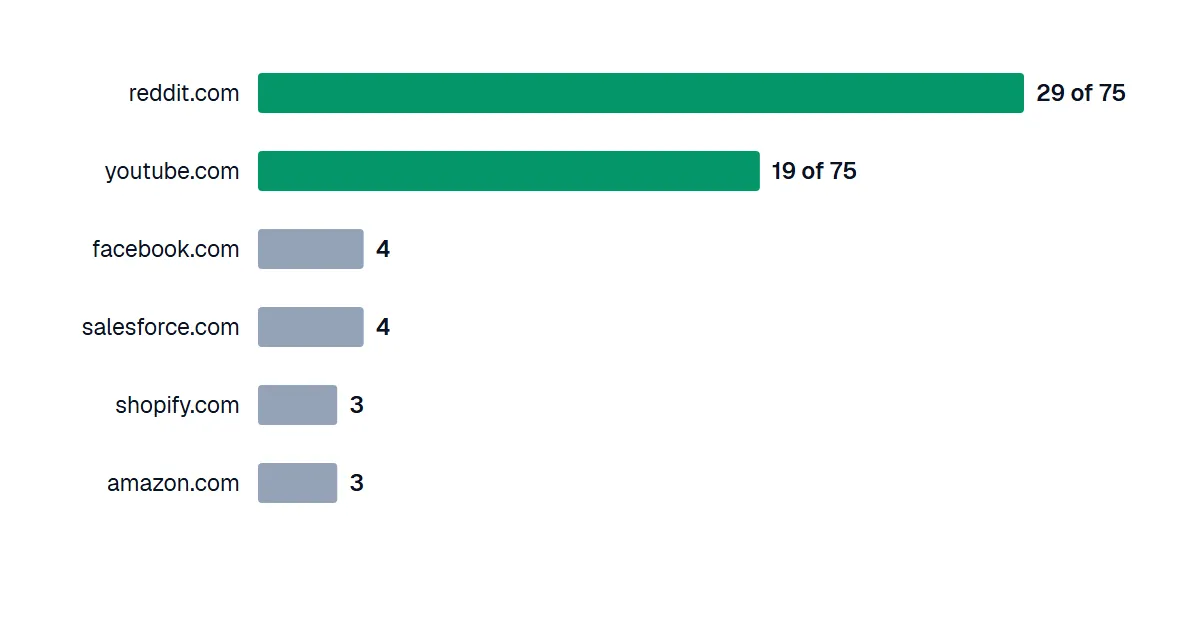
Reddit and YouTube were cited in more AI Overviews than any brand site. Source: Marketing Bar SERP snapshots, DataForSEO, US desktop, 2026-10-24; 75 Overviews that listed sources, across 153 queries.
Three things follow for an LLM SEO plan:
- Organic rank is one route in, not the only one. Two-thirds of cited domains weren't in the organic results for the query, which fits Google's fan-out description. An earlier 38-query check on 2026-10-07 found a similar 31%; what AI Overviews are breaks that study down.
- Community and video pages carry a lot of the answers. Reddit was cited in 29 Overviews and YouTube in 19. In 10 of the 29 Reddit citations, Reddit wasn't in the organic results at all. If buyers discuss your category on Reddit or learn it on YouTube, those threads and videos are part of what the engine reads about you.
- The long tail is open. 114 of 143 cited domains were cited once. After Reddit and YouTube, no domain was cited in more than four Overviews, so most citations went to a page that answered that particular query well.
The "llm seo" query itself shows the same shape. The snapshot returned 9 organic results: five written guides (Yoast, LLMrefs, Marketer Milk, DWAO, Neil Patel), two YouTube videos, one Reddit thread and one B2B trade article. Its AI Overview cited reddit.com, vercel.com and linkedin.com; only Reddit was among the organic results. Of the two guides we read in full, neither publishes measured citation data (Yoast's own numbers come from a survey of SEO practitioners), and they disagree on llms.txt: Yoast recommends it, Neil Patel's guide doesn't mention it, and Google states you "don't need to create new machine readable files, AI text files, or markup" to appear in AI Overviews or AI Mode.
The 153 SERPs are our own DataForSEO pulls (Google organic, US, desktop, English) taken on 2026-10-24, one per article keyword across marketing-bar.com (60), level.marketing-bar.com (25), synergy.marketing-bar.com (18) and intansify.com (50). We counted an AI Overview when the SERP contained one, and compared the domains it cited (deduplicated, "www." ignored) with the domains in that SERP's organic results (6–10 per query, 8.6 on average). 57 of the 132 Overviews listed no cited domains in the snapshot and are excluded from the citation counts. The 38-query figure comes from a separate pull on 2026-10-07. Crawler and product rules are quoted from each vendor's documentation, checked in October 2026. This is one snapshot of our own topics, so the shares show direction and may not hold for your category.
Entity signals: making the model confident enough to name you
Passages get you extracted; entities get you named. When an engine writes "Marketing Bar, a performance agency for DTC brands" instead of "some agencies suggest…", it has enough consistent information to attribute the idea. When it doesn't, your idea can still shape the answer while your brand stays out of it.
The entity checklist:
- One canonical name, everywhere. Site, schema, social profiles, directories. Variant spellings split the entity.
- Organization schema with
sameAspointing at the profiles that corroborate you: LinkedIn, Crunchbase, social accounts. - Article schema with a real author whose byline resolves to an author page with profiles off your domain.
- Third-party presence. The snapshot above shows how much of what AI Overviews cite sits on Reddit, YouTube and other people's sites. A positioning statement that exists only on your homepage has nothing to corroborate it.
- One definition of what you sell. If three pages describe the product three ways, pick one sentence and reuse it.
This is closer to PR hygiene than keyword work, and it compounds. The strategic backdrop is in what GEO means for DTC operators; the entity layer is where it turns into tasks.
ChatGPT SEO in practice, step by step
ChatGPT SEO is making a brand retrievable and citable inside ChatGPT search. OpenAI says ChatGPT search "leverages third-party search providers, as well as content provided directly by our partners" and hasn't said how much comes from each; Bing is the provider most reported (Windows Latest, Nov 2024). OpenAI also runs its own search crawler, OAI-SearchBot. So the work covers both Bing and OpenAI's crawler.
A working sequence for a chatgpt seo program:
Verify the site in Bing Webmaster Tools
Submit sitemaps and check index coverage against what Google has indexed. Since February 2026 the AI Performance report also shows how often Copilot and Bing AI summaries cite your pages and which grounding queries triggered them.
Set the bot rules deliberately
Allow OAI-SearchBot and PerplexityBot if you want to appear in those search products. Block GPTBot or Google-Extended only if you want out of training; neither affects ChatGPT search or Google Search inclusion.
Rebuild the money pages passage-first
"Best X for Y," comparisons and how-to-choose guides are the conversational queries where assistants recommend brands. Give them the section format above.
Map the sources the engine already cites
Run your category's buyer questions and collect every cited URL. Sort them into pages you could legitimately appear on (listicles, review platforms, community threads) and pages you could out-answer on your own domain.
Run a fixed prompt panel
The same set of buyer prompts, on a schedule, through the search-enabled product. Log who is named and who is linked. The AI Overviews tracking guide covers the setup and the mistake we made on our own first run.
ChatGPT's answers shift with product updates, so nobody can guarantee placement. What carries across updates is the substrate: pages the crawlers can fetch, sections that can be lifted, and mentions on sites the engines already cite.
Citation optimization: winning mentions on pages you don't own
Citation optimization is raising how often AI engines cite you, on your own pages or about your brand on pages you don't own. In AI search the cited link is the click; the brands that only inform the answer get nothing back.
On-site, it's everything above. Off-site, it's legitimate presence in the sources the engines already use for your category, which our snapshot says often means Reddit threads, YouTube videos and third-party comparison pages. The sorted URL list from step 4 is the roadmap.
Fake reviews, astroturfed Reddit threads, or paid placements dressed as editorial. Beyond the ethics, a citation profile built on manipulated sources is exposed every time an engine tightens its source-quality filters.
AI Overviews: the passage game with a Google referee
For AI Overviews, a page must be indexed and snippet-eligible, and Google says nothing else is required. Ranking for the exact query helps less than many teams assume: in our snapshot, 64% of cited domains weren't in the organic results for that query. AI Overviews optimization is therefore ordinary SEO plus passage structure on the same page, aimed at the sub-questions as well as the head query.
That changes priorities more than technique. Pages that already rank for question-shaped queries have passed retrieval for at least one fan-out branch, so rewriting their section openers is the cheapest test. New pages get the same format by default. Classic rankings work stays in the plan, which is why we run this as one program under our AI-search optimization service. If the terminology still gets in the way, the glossary piece sorts SEO, GEO and AEO once.
A two-hour LLM SEO check, and where we fit
Start with a two-hour version: run ten buyer prompts through ChatGPT search and Perplexity and note who gets cited for your category; check robots.txt for OAI-SearchBot and PerplexityBot; verify the site in Bing Webmaster Tools; then read your three most important pages and ask whether any section could be lifted out whole and still make sense. Every fix on that list is also ordinary search hygiene. Our free SEO audit runs the crawler-access and indexing half of that check.
If you'd rather have it run for you, our GEO team handles passage-first rebuilds, entity and schema work, citation-source mapping and the prompt panel, alongside the rankings program it depends on. For the broader search engagement, our guide to choosing an ecommerce SEO agency covers what to ask, the Shopify SEO guide covers platform groundwork, smaller teams can start with SEO agency for small business, and the generative engine optimization agency guide covers GEO specialists. The first conversation after you contact us is a scoping one.
FAQ
What is LLM in SEO?
LLM stands for large language model, the kind of model behind ChatGPT, Gemini and Perplexity. LLM SEO means optimizing pages so those systems can fetch them, lift a passage from them and name your brand in the answer, alongside ranking in classic search results.
Is SEO dead now with AI?
No. AI Overviews require a page to be indexed and snippet-eligible in Google, and ChatGPT search draws on third-party search providers plus its own crawler. Indexing, crawl access and authority still decide whether you're a candidate. What changed is that ranking alone no longer decides who gets quoted: in our snapshot, 64% of domains cited in AI Overviews weren't in that query's organic results.
Can ChatGPT do SEO?
It can help with parts of the work: drafting section openers, outlining FAQs, rewriting pronoun-heavy passages, or checking a page against the lift test. It doesn't see your Search Console, Bing or server-log data unless you give it exports, and it can't earn the third-party mentions that drive citations.